
Clopidogrel Resistance in Cats: What Genetics and New Research Reveal
Clopidogrel Resistance in Cats: What Genetics and New Research Reveal
Clopidogrel Resistance in Cats: What Genetics and New Research Reveal
Clopidogrel is an important part of preventing arterial thromboembolism (ATE) in cats with heart disease. However, platelet inhibition varies between patients, and some cats develop thrombotic complications despite treatment.
Recent research and conference discussions have highlighted two potential contributors: genetic differences in platelet function and inflammatory pathways that promote thrombosis. These findings are particularly relevant when deciding whether clopidogrel alone provides sufficient protection.
Clopidogrel remains an important foundation
The FAT CAT trial demonstrated that clopidogrel was more effective than aspirin for preventing recurrent cardiogenic ATE. Median time to recurrence was 443 days with clopidogrel versus 192 days with aspirin. These cats had already experienced an embolic event, so the results specifically support secondary prevention.
Clopidogrel reduces risk, but does not eliminate it. Research into variable drug response helps identify circumstances in which additional protection may be appropriate.
Resistance and treatment failure are different findings
Laboratory resistance describes less platelet inhibition than expected during treatment. Clinical treatment failure describes a thrombotic complication occurring despite therapy.
A recurrent clot alone does not prove genetic resistance. Before attributing an event to inadequate drug response, it is essential to confirm consistent administration and swallowing, review the dose and formulation, and reassess the underlying disease and thrombotic risk.
The genetic connection
Clopidogrel is converted to an active metabolite that inhibits P2Y12, an ADP receptor involved in platelet activation. The best-characterized feline resistance-associated variant affects P2RY1, which encodes a different ADP receptor, P2Y1.
In a 2021 study, 49 cats with hypertrophic cardiomyopathy completed 10–14 days of clopidogrel at 18.75 mg per cat orally every 24 hours. Cats carrying the P2RY1:A236G variant had less inhibition of ADP-induced platelet aggregation than wild-type cats.[2]
The study supports an association between genotype and laboratory response. It did not test whether genotype-guided treatment prevents clinical ATE.
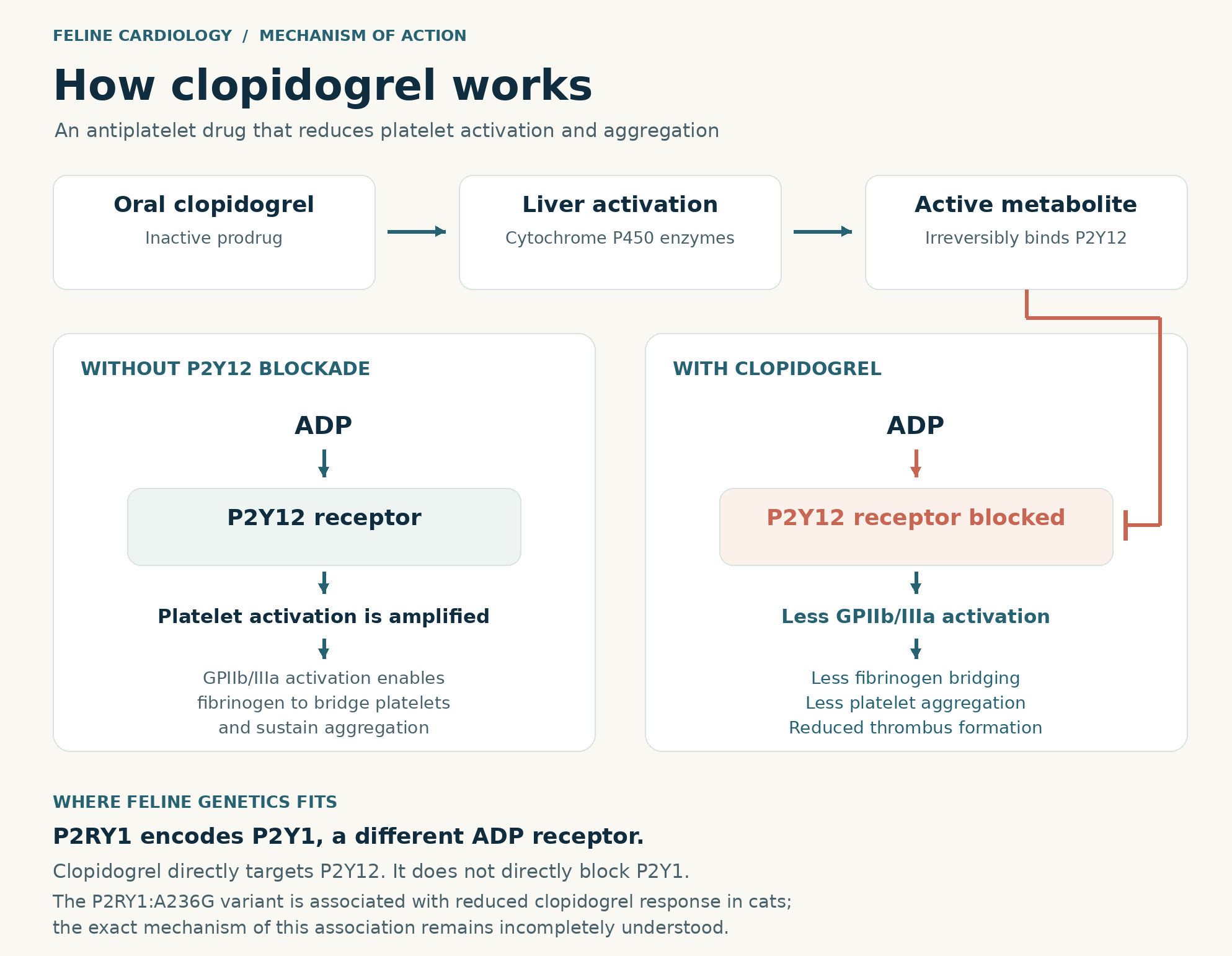
Heterozygous versus homozygous: why two copies may matter
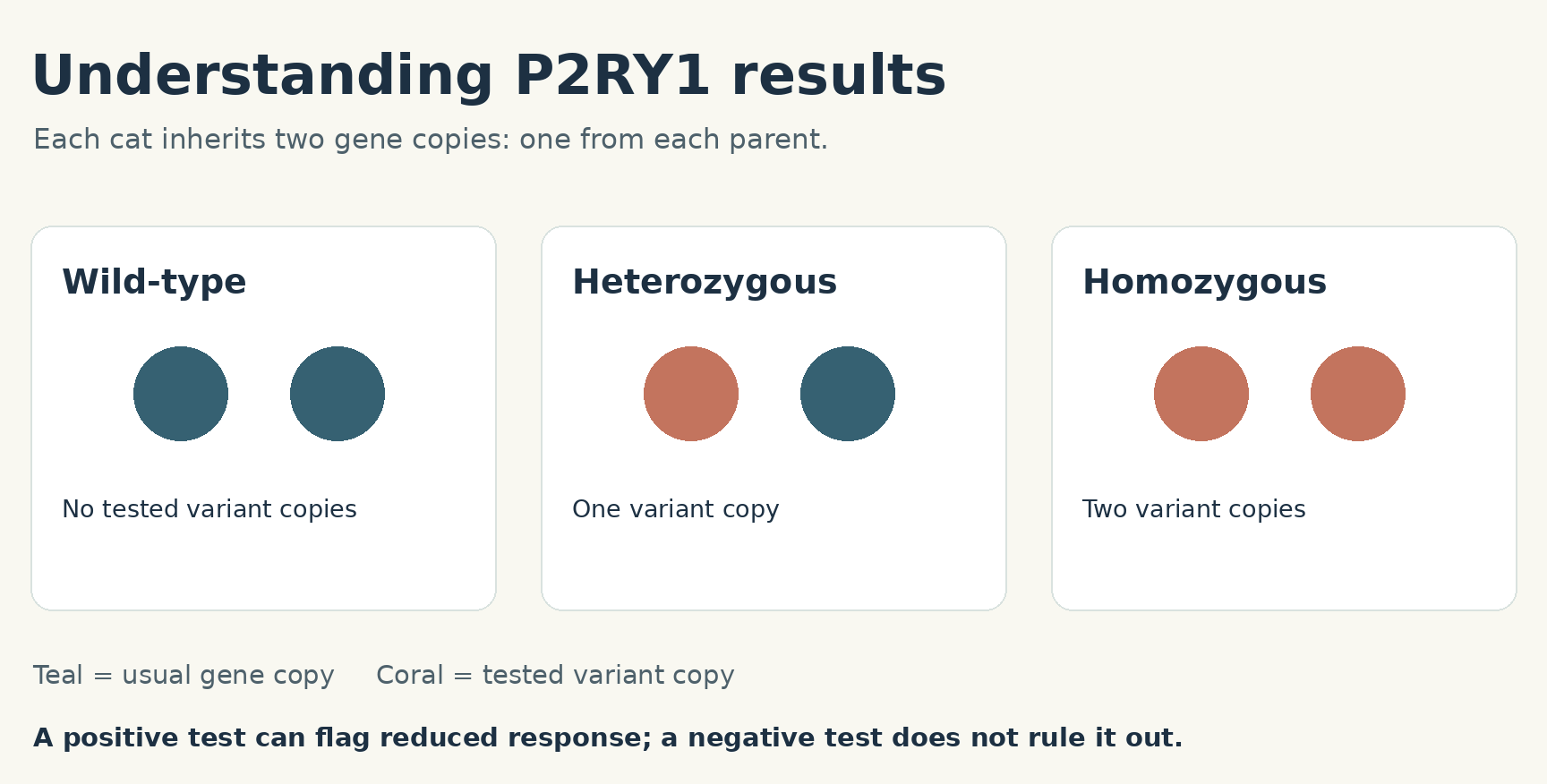
Cats inherit two copies of the P2RY1 gene, one from each parent:
Wild-type: Neither copy carries the tested variant.
Heterozygous: One copy carries the variant.
Homozygous: Both copies carry the variant.
Newer findings suggest that homozygous cats may have a more prothrombotic platelet profile and may be overrepresented among cats experiencing complications during clopidogrel treatment.
What the published study showed
The 2021 study included 49 cats with hypertrophic cardiomyopathy:
P2RY1 result | Number of cats | Percentage |
|---|---|---|
Wild-type | 16 of 49 | 32.7% |
Heterozygous | 25 of 49 | 51.0% |
Homozygous | 8 of 49 | 16.3% |
When variant-positive cats were considered together, they showed less platelet inhibition than wild-type cats. However, the study did not establish that homozygous cats responded worse than heterozygous cats. Only eight cats were homozygous, limiting conclusions about that subgroup.
What the newer conference findings suggest
The NC State Li Lab presented unpublished 2026 findings comparing:
21 cats with documented treatment failure
72 healthy controls without cardiomyopathy
Treatment failure was defined as recurrent cardiovascular events, ATE, spontaneous echocardiographic contrast (SEC), or intracardiac thrombus.
Genotype | Healthy controls | Treatment-failure group | Difference |
|---|---|---|---|
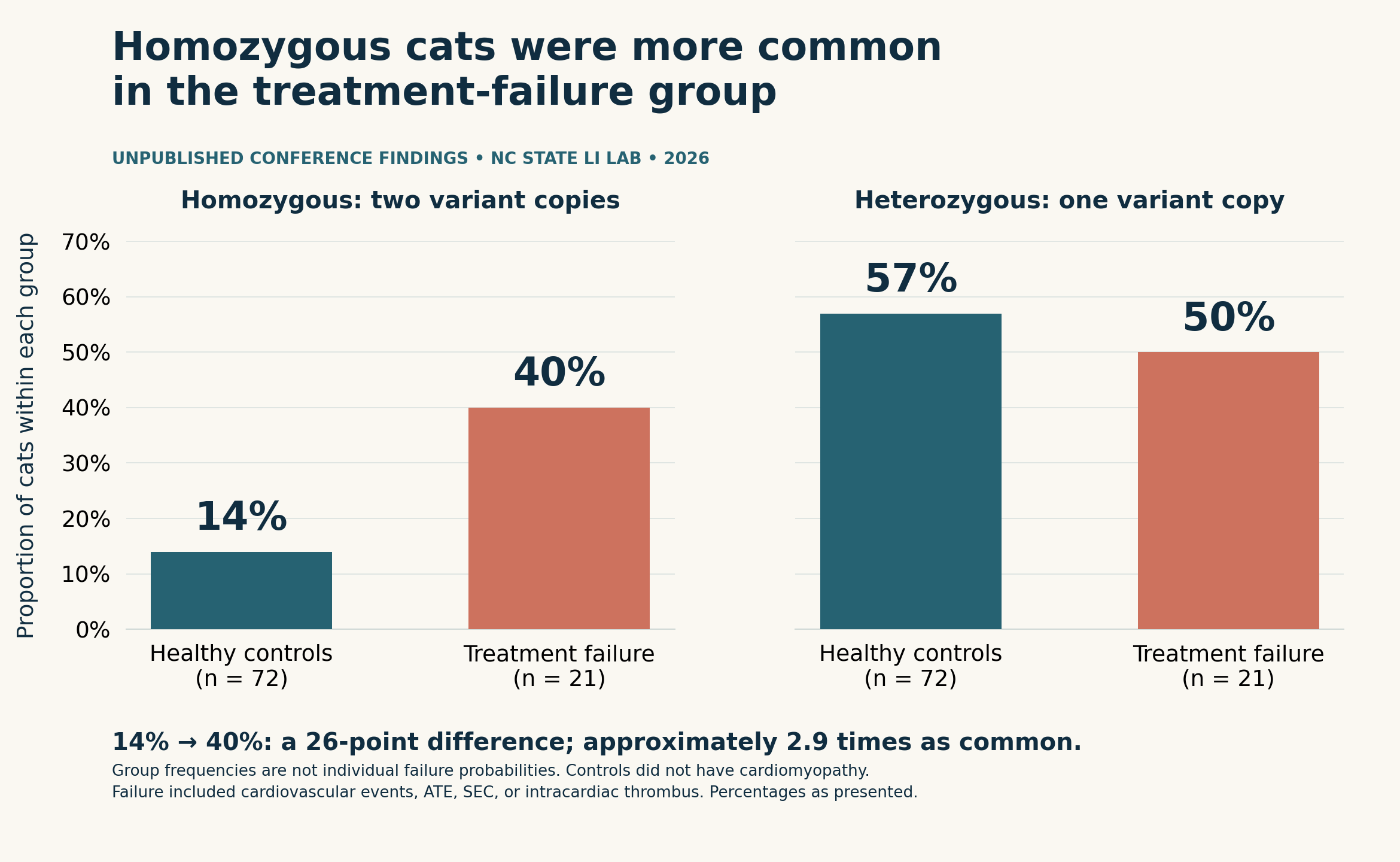
Homozygous | 14% | 40% | 26 percentage points higher |
Heterozygous | 57% | 50% | 7 percentage points lower |
Percentages are reproduced as reported on the conference slide. Exact genotype counts were not provided.
To make those numbers easier to picture, 14% is approximately 1 in 7, while 40% is 2 in 5. Homozygous cats therefore made up a substantially larger share of the treatment-failure group than of the healthy control group.
Using the reported percentages, homozygosity was approximately 2.9 times as common in the treatment-failure group: 40% divided by 14%.
Heterozygous cats, in contrast, accounted for roughly half of both groups: 57% of controls and 50% of the failure group. The slide reported a difference in genotype distribution of P = .005.
The concerning signal was the greater representation of cats carrying two copies of the variant. This does not establish that heterozygous cats have normal drug responses; it suggests that homozygous cats may warrant particular attention.
Why the platelet findings add to the concern
Additional preliminary conference findings described greater platelet reactivity in homozygous cats compared with wild-type cats.
A separate flow-based laboratory assay showed a shorter time to channel occlusion, meaning a blockage formed more quickly under the test conditions.
Together, these observations suggest that homozygous cats may have platelets that activate more readily and blood that forms an occlusive thrombus more quickly in laboratory testing. This offers a possible biological explanation for their greater representation in the treatment-failure group.
What these numbers cannot tell us
The findings do not establish a 2.9-fold greater risk of treatment failure. That comparison describes how frequently homozygosity appeared in the two selected groups, not an individual cat’s likelihood of developing a clot.
Likewise, 40% does not mean that 40% of homozygous cats will fail clopidogrel treatment. It means that 40% of the cats already identified as having treatment failure were homozygous.
Controls were healthy rather than cats with cardiomyopathy successfully receiving clopidogrel. The study therefore cannot determine how much of the difference reflects drug response, underlying disease, or other factors. Its broad failure definition also prevents interpretation solely as a risk of recurrent ATE.
These preliminary findings raise a meaningful concern that homozygous cats may represent a higher-risk subgroup. Further studies are needed to quantify that risk and determine which treatment strategy provides the best protection.
Genetic testing can inform the plan
NC State offers P2RY1 testing using a cheek swab or EDTA whole blood. The listed laboratory price is $60, excluding clinic collection and submission charges.
A positive result identifies a variant associated with reduced platelet inhibition. A negative result does not exclude poor response from other causes. Genetic results should be interpreted alongside cardiac findings, clot history, and treatment tolerance.
Genotyping does not measure platelet inhibition during treatment. Specialized platelet-function testing addresses that question, although access and sample handling can be challenging. Routine TEG or VCM results should not be used alone to confirm adequate clopidogrel response.
Inflammation may contribute beyond genetics
The conference also explored immunothrombosis: interactions between the immune system, platelets, and coagulation that promote clot formation.
Neutrophils can release extracellular traps, or NETs, composed of DNA and associated proteins. Published feline studies have identified NETs in cardiogenic arterial thrombi and circulating NET-associated markers in cats with HCM and cardiogenic ATE.
Experimental findings presented at the conference suggested that citrullinated histones can prime feline platelets and weaken inhibitory signaling through pathways independent of P2Y12.
These findings offer a possible explanation for persistent platelet activation despite blockade of clopidogrel’s target. Further research is needed to establish how these mechanisms should influence clinical treatment.
What does the evidence say about dual therapy?
Combining clopidogrel with an anticoagulant such as rivaroxaban targets two complementary mechanisms: platelet activation and factor Xa-dependent coagulation.
ACVIM consensus guidance supports considering additional antithrombotic therapy in cats believed to be at very high risk of ATE, although the evidence supporting escalation is limited.
A retrospective series of 32 cats receiving clopidogrel and rivaroxaban included patients with previous ATE, intracardiac thrombus, or SEC. Five experienced potentially medication-related bleeding, although none required hospitalization for those events. The reported ATE recurrence rate was 16.7% among cats with prior ATE.
These findings are encouraging, but the study had no concurrent monotherapy control group and cannot establish superiority. Experimental research also supports complementary effects of the combination on platelet function and thrombin generation.
The SUPERCAT trial provides additional context. It compared rivaroxaban alone with clopidogrel alone in 45 cats that had recovered from cardiogenic ATE. Recurrence occurred in 39% and 37%, respectively, without a significant difference in time to recurrence or survival.
It did not compare dual therapy with monotherapy or specifically evaluate homozygous cats.
Rivaroxaban versus apixaban: how do they compare?
Both rivaroxaban and apixaban are direct factor Xa inhibitors. They reduce thrombin generation through a mechanism that complements clopidogrel’s antiplatelet effects.
Rivaroxaban currently has the stronger feline clinical evidence base, including the SUPERCAT trial and the retrospective clopidogrel–rivaroxaban series discussed above.
Apixaban has feline pharmacokinetic and pharmacodynamic data demonstrating factor Xa inhibition, but evidence for prevention of clinical ATE is less developed.
Feature | Rivaroxaban | Apixaban |
|---|---|---|
Mechanism | Direct factor Xa inhibition | Direct factor Xa inhibition |
Feline clinical evidence | Clinical outcomes studies, including SUPERCAT and a dual-therapy case series | Primarily pharmacokinetic/pharmacodynamic studies and emerging experimental evidence |
Regimen in the 2026 comparison | 2.5 mg/cat orally every 24 hours | 1.25 mg/cat orally every 12 hours |
Practical consideration | Once-daily administration | Twice-daily administration |
These are regimens used in the comparative study, not interchangeable prescriptions or a validated genotype-specific protocol. https://cardiaceducationgroup.org/wp-content/uploads/2015/11/CEG_Feline-Formulary.pdf
New comparative findings from the 2026 ACVIM Forum
A blinded, randomized crossover study in 10 healthy cats compared clopidogrel alone with clopidogrel plus rivaroxaban or apixaban. Each active regimen was administered for seven days.
The researchers reported:
Both combinations reduced maximum ADP-induced platelet aggregation compared with placebo.
Only the rivaroxaban combination significantly delayed platelet-dependent thrombin generation compared with clopidogrel alone.
No adverse effects were observed during the short treatment periods.
The authors interpreted the rivaroxaban combination as producing greater complementary antithrombotic effects at the doses studied.
However, this was a conference abstract involving laboratory endpoints in healthy cats. It did not measure recurrent ATE, survival, long-term bleeding, or outcomes in homozygous cats. A significant result for one regimen and a nonsignificant result for another also does not, by itself, establish a statistically significant difference between the regimens.
These preliminary findings add to the rationale for considering rivaroxaban when selecting a partner for clopidogrel. They do not establish that rivaroxaban prevents more clinical events than apixaban.
Monitoring considerations
With either drug, assess bleeding risk, renal and hepatic function, concurrent medications, and administration feasibility.
If anti-Xa testing is pursued, request the drug-specific calibrated assay. Apixaban and rivaroxaban assays are not interchangeable, and validated feline therapeutic targets remain limited.
Increasing the dose and emerging therapies
A positive genetic result does not establish a validated higher clopidogrel dose. The available evidence does not provide a genotype-specific dose-escalation protocol that reliably prevents clinical events.
Cilostazol was discussed at the conference as a potential adjunct targeting platelet inhibitory signaling relevant to NET-associated activation. The findings were preliminary, with further studies needed. Cilostazol remains an investigational option in this setting.
Clinical Pearls
Homozygous results deserve attention: Preliminary findings suggest greater platelet reactivity and an association with treatment failure.
Read the numbers correctly: Homozygosity was approximately 2.9 times as common in the failure group; this is not a proven 2.9-fold increase in individual risk.
Previous thrombosis matters: Intracardiac thrombus or ATE history should inform reassessment of the prevention plan.
Consider the whole cardiac picture: Atrial enlargement or dysfunction, SEC, and intracardiac thrombus add to concern.
Confirm administration: Check the dose, formulation, and consistent swallowing before attributing an event to resistance.
A negative test is not a guarantee: Poor response can have other causes.
Rivaroxaban has more feline clinical evidence: Apixaban remains an alternative, with less clinical outcomes evidence.
Individualize treatment: Balance thrombotic risk against bleeding risk, organ function, tolerance, and administration.
Recognize the evidence gap: A genotype-specific dual-therapy protocol has not been validated in a clinical outcomes trial.
My Clinical Perspective
I would strongly consider dual antithrombotic therapy in cats homozygous for the P2RY1 variant, as well as cats with a history of intracardiac thrombosis or arterial thromboembolism. Marked atrial enlargement, impaired atrial function, or SEC would strengthen that consideration.
For these patients, I would discuss combining clopidogrel with an anticoagulant such as rivaroxaban rather than waiting for another thrombotic event. A homozygous result should prompt a thoughtful review of whether clopidogrel alone provides sufficient protection.
Rivaroxaban currently has the stronger feline evidence base for this combination, including clinical outcome data and preliminary comparative findings. Apixaban may be considered as an alternative, with drug selection individualized to the patient. Neither combination has been validated specifically for homozygous cats in a clinical outcomes trial.
The final plan should account for bleeding risk, renal and hepatic function, concurrent medications, tolerance, and the family’s ability to administer treatment consistently.
This reflects my clinical interpretation of the available evidence and preliminary conference findings. A genotype-specific dual-therapy protocol has not yet been validated in a clinical outcomes trial.
Medication changes should be directed by the treating veterinarian. Clopidogrel, rivaroxaban, and apixaban use in cats is extra-label.
References
Hogan DF, et al. Secondary prevention of cardiogenic arterial thromboembolism in the cat: the double-blind, randomized, positive-controlled feline arterial thromboembolism; clopidogrel vs. aspirin trial (FAT CAT). Journal of Veterinary Cardiology. 2015;17 Suppl 1:S306–S317.
https://pubmed.ncbi.nlm.nih.gov/26776588/Ueda Y, et al. A genetic polymorphism in P2RY1 impacts response to clopidogrel in cats with hypertrophic cardiomyopathy. Scientific Reports. 2021;11:12522.
https://doi.org/10.1038/s41598-021-91372-3NC State Li Lab. Conference presentation slides reviewed by Christina Bové, October 2026. Includes unpublished 2026 findings on P2RY1 genotype frequencies, platelet reactivity, and potential adjunctive therapies. Unpublished conference material; no public link available.
NC State Veterinary Hospital. Feline Clopidogrel Resistance. Accessed November 8, 2026.
https://hospital.cvm.ncsu.edu/services/small-animals/genetics/glanzman-thrombocytopenia/Rosati T, Jandrey KE, Stern JA, Nguyen N, Li RHL. Evaluation of clopidogrel response in healthy cats using a novel viscoelastic test and thromboelastography. Frontiers in Veterinary Science. 2024;11:1371781.
https://doi.org/10.3389/fvets.2024.1371781Li RHL, et al. Circulating neutrophil extracellular traps in cats with hypertrophic cardiomyopathy and cardiogenic arterial thromboembolism. Journal of Veterinary Internal Medicine. 2023;37:490–502.
https://doi.org/10.1111/jvim.16676Li RHL, Nguyen N, Stern JA, Duler LM. Neutrophil extracellular traps in feline cardiogenic arterial thrombi: a pilot study. Journal of Feline Medicine and Surgery.
https://doi.org/10.1177/1098612X211044986Brainard BM, et al. Therapy with clopidogrel or rivaroxaban has equivalent impacts on recurrence of thromboembolism and survival in cats following cardiogenic thromboembolism: the SUPERCAT study. Journal of the American Veterinary Medical Association. Published online December 18, 2024; print 2025.
https://doi.org/10.2460/javma.24.09.0584Lo ST, Walker AL, Georges CJ, Li RHL, Stern JA. Dual therapy with clopidogrel and rivaroxaban in cats with thromboembolic disease. Journal of Feline Medicine and Surgery. 2022;24(4):277–283.
https://pmc.ncbi.nlm.nih.gov/articles/PMC8830184/Lo ST, et al. Synergistic inhibitory effects of clopidogrel and rivaroxaban on platelet function and platelet-dependent thrombin generation in cats. Journal of Veterinary Internal Medicine. 2023.
https://pmc.ncbi.nlm.nih.gov/articles/PMC10365033/ACVIM consensus statement guidelines for the classification, diagnosis, and management of cardiomyopathies in cats. Journal of Veterinary Internal Medicine. 2020;34:1062–1077.
https://pmc.ncbi.nlm.nih.gov/articles/PMC7255676/Weitzhandler EC, presenter. Antithrombotic and Antiplatelet Effects of Dual Therapy with Clopidogrel-Rivaroxaban Versus Clopidogrel-Apixaban in Healthy Cats. 2026 ACVIM Forum. Research abstract C10; June 11, 2026. Conference abstract.
https://2026acvimforum.eventscribe.net/fsPopup.asp?PresentationID=1828304&mode=presInfoPharmacokinetics and pharmacodynamics of the factor Xa inhibitor apixaban after oral and intravenous administration to cats. American Journal of Veterinary Research. 2015;76:732–738.
https://pubmed.ncbi.nlm.nih.gov/26207972/Cornell University Animal Health Diagnostic Center. Apixaban Anticoagulant Monitoring. Accessed November 8, 2026.
https://www.vet.cornell.edu/animal-health-diagnostic-center/testing/testing-protocols-interpretations/apixaban-anticoagulant-monitoring



Empowering Your Path to Wellness


Quick Links
HomeTitle
About Us
Services
Testimonials
FAQ's
Blog