
Diet-Associated Dilated Cardiomyopathy in Dogs: From Grain-Free Diets to Cellular Biology — Part 2
Diet-Associated Dilated Cardiomyopathy in Dogs: From Grain-Free Diets to Cellular Biology — Part 2
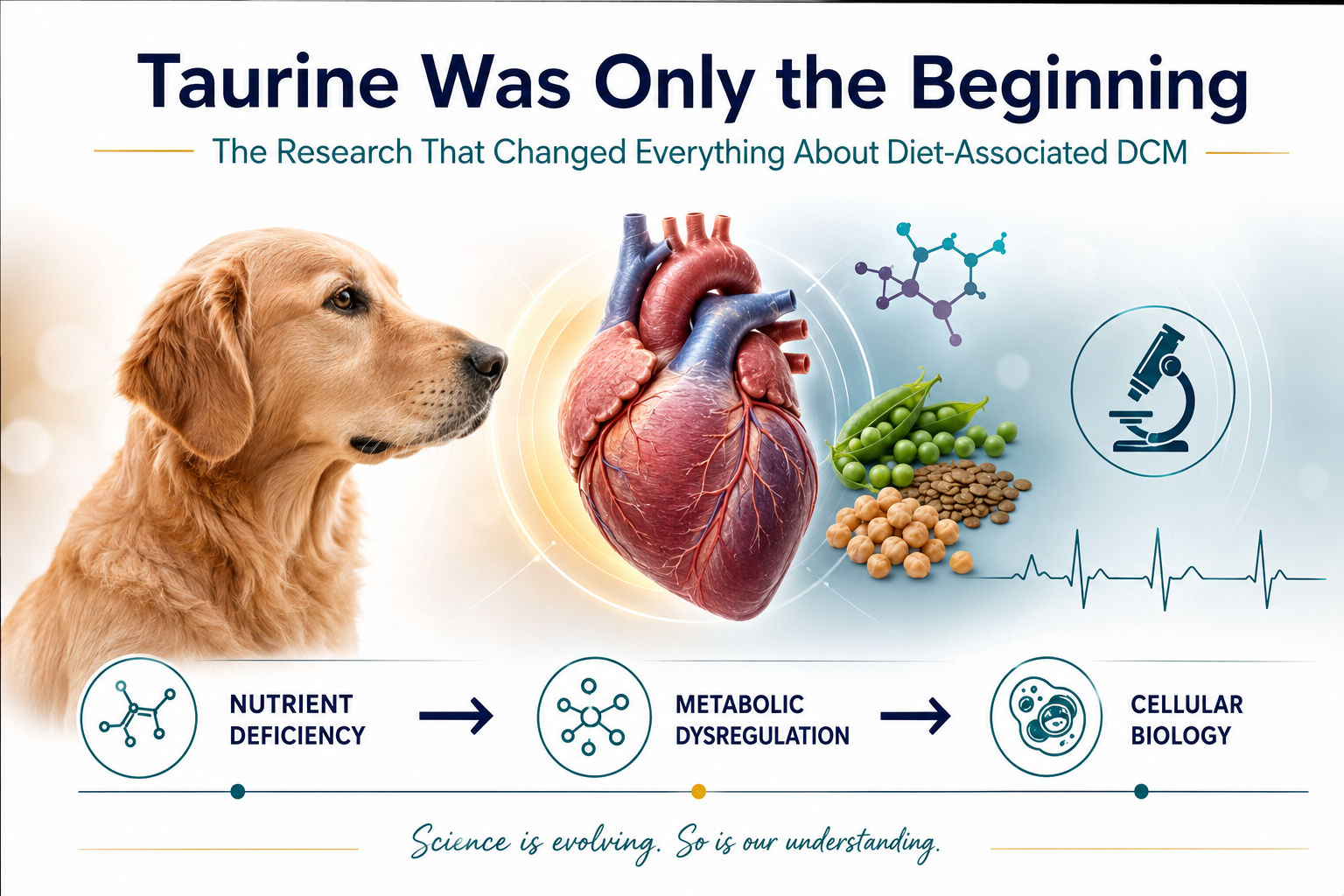
Taurine Was Only the Beginning: The Research That Changed Everything About Diet-Associated DCM
By Christina Bové, DVM, MS, DACVIM (Cardiology)
In Part 1, we explored how the conversation surrounding diet-associated dilated cardiomyopathy (daDCM) evolved from a focus on grain-free diets to a broader understanding involving pulse ingredients, metabolism, and individual susceptibility.
But one important question remained:
If grains aren't the answer, then what is?
For many years, taurine deficiency seemed like the most logical explanation. After all, taurine deficiency had already been established as a cause of reversible cardiomyopathy in cats and some dogs.
However, as additional studies accumulated, investigators realized the story was considerably more complex.
Today, researchers are no longer searching for a single missing nutrient. Instead, they are investigating how diet influences metabolism, biochemical pathways, and ultimately cellular function.
The Original Nutritional Cardiomyopathy
Long before the current concerns surrounding diet-associated DCM, veterinary cardiologists recognized that nutrition could directly affect heart function.
In 1987, Pion and colleagues published one of the most influential papers in veterinary medicine. Their landmark study demonstrated that taurine deficiency caused a reversible form of dilated cardiomyopathy in cats. Taurine supplementation resulted in dramatic clinical improvement and permanently changed feline nutrition.
This discovery established two concepts that continue to influence veterinary cardiology today:
Nutritional deficiencies can cause heart disease.
Some cardiomyopathies are reversible.
Those principles would later shape how veterinarians approached modern cases of diet-associated DCM.
American Cocker Spaniels: Proof That Nutritional Cardiomyopathy in Dogs Isn't New
Although taurine deficiency is often associated with cats, one of the most important canine examples came from the American Cocker Spaniel.
In the 1990s, Kittleson and colleagues (MUST trial: Multicenter Spaniel Trial) described American Cocker Spaniels with dilated cardiomyopathy and decreased plasma taurine and carnitine concentrations. Many of these dogs experienced substantial improvement following taurine and L-carnitine supplementation in combination with conventional heart failure therapy.
Affected dogs demonstrated:
Improved systolic function
Improved cardiac chamber sizes
Resolution of clinical signs
Prolonged survival.
These studies established that nutritional cardiomyopathy could occur in dogs and, importantly, that it could be reversible.
For many veterinary cardiologists, the Cocker Spaniel studies provided early evidence that not all DCM behaves like inherited disease.
Taurine Deficiency in Dogs
Subsequent studies identified taurine-responsive cardiomyopathy in additional breeds, including:
Golden Retrievers
Newfoundlands
English Cocker Spaniel
Because taurine deficiency had already been established as a cause of cardiomyopathy in both cats and some dogs, many early investigators suspected taurine deficiency was responsible for the newly recognized cases of diet-associated DCM.
Taurine Was Only Part of the Story
Taurine Was Only Part of the Story
By the time cardiologists began recognizing increasing numbers of dogs with suspected diet-associated DCM, taurine deficiency seemed like the obvious answer.
After all, veterinary medicine had seen this story before.
Nutritional cardiomyopathies had already been described in cats and in several canine breeds, and many of those patients improved with supplementation and conventional heart failure therapy. Those earlier discoveries taught us an important lesson: some forms of cardiomyopathy are reversible.
Because of this history, taurine deficiency became the natural starting point for investigating modern cases.
And taurine still matters.
Even today, many cardiologists recommend measuring whole blood taurine concentrations in dogs with DCM, ventricular arrhythmias, atypical breed presentations, or unexplained systolic dysfunction. Since supplementation is inexpensive and generally safe, taurine is frequently initiated while results are pending.
Initially, the pieces seemed to fit.
Then the story became more complicated.
As additional cases accumulated, researchers noticed that many affected dogs had normal taurine concentrations despite severe systolic dysfunction. Some experienced substantial reverse remodeling after dietary modification despite normal taurine levels. Cases also began appearing in breeds and mixed-breed dogs not traditionally associated with DCM, and many affected dogs demonstrated better survival and greater improvement than dogs with inherited disease.
These observations suggested that taurine deficiency, while important, could not fully explain what cardiologists were seeing.
The growing number of reports eventually prompted the FDA to launch an investigation in 2018. Many affected dogs had been consuming diets containing peas, lentils, chickpeas, potatoes, and other pulse ingredients. Importantly, the FDA has consistently emphasized that no single ingredient has been identified and that the disease likely represents a multifactorial process.
Perhaps the most striking observation was not simply that these dogs developed DCM—but that many improved after diet change. Improvement in heart size and function, prolonged survival, and reverse remodeling are features that distinguish secondary nutritional cardiomyopathies from primary inherited DCM and helped convince clinicians that they were observing something fundamentally different.
By this point, researchers began to suspect they might be asking the wrong question.
For years, the focus had been:
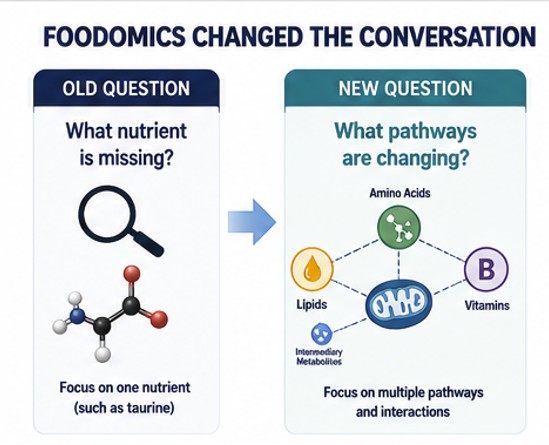
What nutrient is missing?
But perhaps the answer wasn't a missing nutrient at all.
Instead, investigators began asking:
What metabolic pathways are being altered?
That shift would usher in the era of metabolomics, foodomics, and eventually cellular biology—changing how we think about diet-associated DCM today.
Foodomics Revealed a Metabolic Signature
Foodomics Revealed a Metabolic Signature
Once researchers began looking beyond traditional nutrient deficiencies, the tools available to study diet-associated DCM changed dramatically.
Rather than measuring one nutrient at a time, investigators could now evaluate hundreds of compounds simultaneously.
One of the most important turning points came with the Tufts foodomics study.
Investigators analyzed hundreds of compounds present within commercial dog foods and discovered that diets associated with reported DCM cases possessed distinct biochemical fingerprints compared with more traditional diets.
Importantly, no single nutrient emerged as "the answer."
Instead, differences involved multiple pathways, including:
Sulfur amino acid metabolism
Lipid metabolism
Intermediary metabolites
Amino acid pathways
B vitamins and related compounds
Dozens of compounds differed between diet groups.
Perhaps most notably, peas demonstrated some of the strongest associations with these metabolic signatures.
These findings suggested that diet-associated DCM may represent a complex systems-level disorder rather than a classic deficiency disease.
Pulse Burden Emerges
As the science evolved, researchers recognized that simply labeling foods as "grain-free" failed to capture the complexity of ingredient formulation.
Attention shifted toward a newer concept:
Pulse Burden
In other words:
How much pulse-derived material is present within the diet?
Researchers also began considering:
Pulse Diversity
How many different pulse ingredients are included?
Pulse Fractions
Examples include:
Peas;
Pea protein
Pea fiber
Pea starch
Lentils
Chickpeas.
Although these ingredients appear separately on ingredient labels, many originate from the same source.
A food containing peas, pea protein, pea fiber, and pea starch may effectively contain multiple pea-derived ingredients despite appearing more diverse on the label.
Increasing evidence suggested that ingredient quantity and concentration may matter more than whether a diet contains grains.
The conversation had officially moved beyond the grain-free era.
Could Changes Occur Before Heart Disease Develops?
One of the challenges in studying diet-associated DCM is that most affected dogs are identified after cardiac changes have already occurred.
This raises an important question:
Do metabolic changes develop before detectable heart disease, or are they simply a consequence of it?
To answer this question, researchers needed to study healthy dogs before cardiac abnormalities appeared.
The Quilliam Feeding Studies
A series of studies led by Chloe Quilliam and colleagues helped answer this question by evaluating healthy Beagles consuming pulse-containing diets under controlled conditions.
Rather than studying dogs with established disease, investigators examined how different dietary ingredients influenced metabolism, nutrient utilization, and cardiac physiology in otherwise healthy animals.
Their findings would provide some of the strongest experimental evidence to date that dietary effects may occur long before clinical disease becomes apparent.
The 2021 Digestibility Study
In 2021, Quilliam and colleagues evaluated healthy Beagles consuming grain-containing and pulse-based diets in a randomized crossover design.
The diets included ingredients such as:
Smooth peas, wrinkled peas lentils, fava beansice-based controls.
Investigators evaluated:
Nutrient digestibility
Glycemic responses
Plasma taurine concentrations
Fecal bile acid excretion
Smino acid utilization.
Several interesting findings emerged.
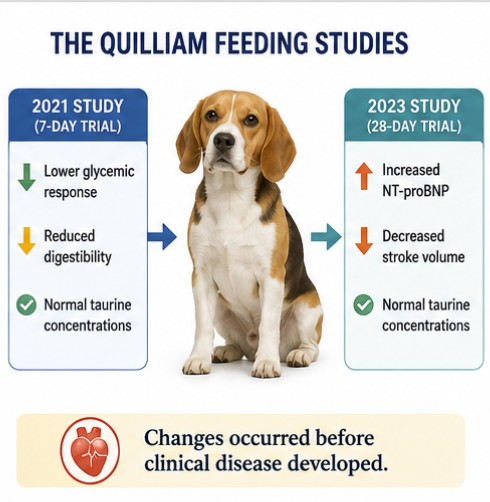
Pulse-containing diets produced lower fasting and post-prandial glucose concentrations than the rice-based control diet, suggesting potential metabolic benefits associated with these ingredients.
However, pulse-based diets also reduced digestibility of several nutrients, particularly in diets containing higher concentrations of fiber and amylose.
Importantly, digestibility of protein and sulfur-containing amino acids was lower in some pulse-containing diets.
Despite these changes:
Plasma taurine concentrations remained normal
No dogs developed cardiac disease
Unexpectedly, fecal bile acid losses were not increased, challenging one of the leading theories proposed to explain taurine depletion in dogs consuming pulse-rich diets.
The study suggested that pulse ingredients can influence nutrient utilization and metabolism without necessarily causing immediate taurine deficiency.
Could Diet Affect the Heart in Just 28 Days?
The same research group later asked a more ambitious question:
Could dietary effects on cardiac function be detected in healthy dogs before overt disease develops?
To answer this question, they conducted a 28-day randomized crossover study in healthy adult Beagles.
The results surprised many researchers.
After only four weeks, dogs consuming the wrinkled pea diet demonstrated:
Increased left ventricular internal diameter in systole (LVIDs)
Decreased stroke volume
Decreased cardiac output
increased NT-proBNP concentrations
At the same time:
Dogs remained clinically healthy
Cardiac troponin concentrations remained unchanged
Taurine concentrations remained within normal limits
Additionally, plasma methionine concentrations decreased in dogs consuming the wrinkled pea diet, suggesting that alterations in sulfur amino acid metabolism may occur before taurine concentrations become abnormal.
Why the 28-Day Study Was So Important
The significance of this study was not that the dogs developed dilated cardiomyopathy.
They did not.
All measured values remained within normal reference intervals, and no dog developed clinical heart disease.
Instead, the importance of the study was that measurable changes occurred at all.
The dogs were healthy, had no known genetic predisposition, normal taurine concentrations and developed measurable physiologic changes within only four weeks.
Perhaps most intriguingly, the wrinkled pea diet produced more pronounced effects than the lentil diet, suggesting that not all pulse ingredients exert identical metabolic influences.
This observation reinforced the growing idea that pulse burden alone may not tell the entire story.
Different ingredients may affect different biologic pathways.
Looking Ahead
The story of diet-associated DCM was no longer centered on a missing nutrient.
Researchers had begun exploring metabolism itself.
But another important question remained:
What is happening inside the cardiac cell?
In Part 3, we'll explore:
Autophagy and Beclin-1
Lysosomal dysfunction
Phospholipidosis
Mitochondrial injury
Emerging mechanistic models that may finally explain why diet-associated DCM occurs
The story becomes even more fascinating from there.
References
Foundational Taurine Literature
Pion PD, Kittleson MD, Rogers QR, Morris JG.
Myocardial failure in cats associated with low plasma taurine concentrations.
Science. 1987;237(4816):764-768.
https://doi.org/10.1126/science.3616607
Kittleson MD, Keene BW, Pion PD, Loyer CG.
Results of the Multicenter Spaniel Trial (MUST): Taurine- and carnitine-responsive dilated cardiomyopathy in American Cocker Spaniels with decreased plasma taurine concentration.
Journal of Veterinary Internal Medicine. 1997;11(4):204-211.
https://doi.org/10.1111/j.1939-1676.1997.tb00092.x
Backus RC, Cohen G, Pion PD, et al.
Taurine deficiency in Newfoundlands fed commercial diets.
Journal of the American Veterinary Medical Association. 2003;223:1130-1136.
Diet-Associated DCM
Freeman LM, Stern JA, Fries R, Adin DB, Rush JE.
Diet-associated dilated cardiomyopathy in dogs: What do we know?
Journal of the American Veterinary Medical Association. 2018;253(11):1390-1394.
Kaplan JL, Stern JA, Fascetti AJ, et al.
Taurine deficiency and dilated cardiomyopathy in Golden Retrievers fed commercial diets.
PLoS One. 2018;13:e0209112.
Ontiveros ES, et al.
Development of taurine deficiency and DCM in Golden Retrievers fed commercial diets.
PLoS One. 2020.
Donadelli RA, et al.
Ingredient composition and pulse content in canine diets.
Translational Animal Science. 2020.
Adin DB, et al.
Clinical findings and outcomes in dogs with suspected diet-associated DCM.
Journal of Veterinary Internal Medicine. 2021.
Walker AL, et al.
Echocardiographic changes and recovery in dogs with diet-associated DCM.
Journal of Veterinary Cardiology. 2021.
Foodomics and Metabolomics
Smith CE, Parnell LD, Lai CQ, et al.
Investigation of diets associated with dilated cardiomyopathy in dogs using foodomics analysis.
Scientific Reports. 2021;11:15881.
Smith CE, et al.
Metabolomic alterations associated with diet-associated dilated cardiomyopathy in dogs.
Scientific Reports. 2022.
Feeding Studies
Quilliam C, Ren Y, Morris T, Ai Y, Weber LP.
Effects of pulse-based diets on nutrient digestibility and metabolic responses in dogs.
Frontiers in Veterinary Science. 2021.
Quilliam C, Reis LG, Ren Y, Ai Y, Weber LP.
Effects of a 28-day feeding trial of grain-containing versus pulse-based diets on cardiac function, taurine levels, and digestibility in domestic dogs.
PLoS One. 2023;18:e0285381.
Review Articles
McCauley SR, et al.
Review of canine dilated cardiomyopathy in the wake of diet-associated concerns.
Frontiers in Animal Science. 2020.
Mansilla WD, et al.
The association between pulse ingredients and canine nutrition.
Journal of Animal Science. 2019.
Websites and Educational Resources
U.S. Food and Drug Administration (FDA).
Investigation into Potential Link Between Certain Diets and Canine Dilated Cardiomyopathy.
https://www.fda.gov/animal-veterinary/outbreaks-and-advisories/fda-investigation-potential-link-between-certain-diets-and-canine-dilated-cardiomyopathy
Tufts Petfoodology.
Diet-Associated DCM: Research Update.
https://sites.tufts.edu/petfoodology/2021/09/03/diet-associated-dcm-research-update/
Tufts Petfoodology.
Diet-Associated Dilated Cardiomyopathy: The Cause Is Not Yet Known, But It Hasn't Gone Away.
https://sites.tufts.edu/petfoodology/2023/02/07/diet-associated-dilated-cardiomyopathy-the-cause-is-not-yet-known-but-it-hasnt-gone-away/
Tufts Petfoodology.
It's Not Just Grain-Free: An Update on Diet-Associated DCM.
https://sites.tufts.edu/petfoodology/2018/11/29/dcm-update/
Tufts Petfoodology.
DCM Resource Archive.
https://sites.tufts.edu/petfoodology/tag/dcm/
Tufts Cummings School of Veterinary Medicine.
Heart Disease and Nutrition.
https://vet.tufts.edu/foster-hospital-small-animals/specialty-services/cardiology/heartsmart/heart-disease-nutrition
Personal Communications and Presentations
Freeman LM.
ACVIM Forum presentations (2022–2026).
Freeman LM.
Tufts University lectures and educational updates.



Empowering Your Path to Wellness


Quick Links
HomeTitle
About Us
Services
Testimonials
FAQ's
Blog